Process Safety
Safety Culture
How important is safety to you and those around you? What does process safety mean? What does it mean to your company? Are you willing to work for a company that does not value safety? Is it true that a company that does not value safety does not value you?
Ultimately, we are responsible for our safety, both physical and spiritual. We’ll talk about many accidents in the course. For example, a few days ago, the Los Angeles Times reported about Zuko Carrasco, who was paralyzed while leading people on a trust fall. He blames himself as he was the last to descend when what he thought he heard was “on belay” but his belayer was not yet ready. He jumped and fell 40 feet and was paralyzed from the waist down. He had safely completed that activity many times before.
Inherent Safety Principles
| Principle | Example |
|---|---|
| Minimization | Reducing the quantity of smokeless powder from which an operator dispenses a portion for use with an explosive article |
| Downsizing | Reducing the number of people exposed; e.g. moving an operation from a central area with more people present to one where fewer people are exposed |
| Isolation | Adding a shield to an explosive article no-fire test station |
| Substitution | Replacing lead styphnate and lead azide with a non-lead substitute (maybe Sodium 5-nitrotetrazolato-N2 (NaMNT)) for small-arms primers |
| Moderation | Reducing the operating temperature of a drying operation |
| Simplification | Removing old piping or dead legs that are no longer used in a piping and pumping system |
Safety Controls
Inherent: Design the process to eliminate or reduce hazards.
Engineering:
Passive: Safety features that do not require action to function (e.g., dikes, relief valves).
Active: Safety features that require action to function (e.g., alarms, interlocks).
Procedural: Administrative controls such as training, procedures, and policies
Personal Protective Equipment (PPE): Equipment worn by workers to protect against hazards (e.g., gloves, goggles, respirators).
Safety Triangle
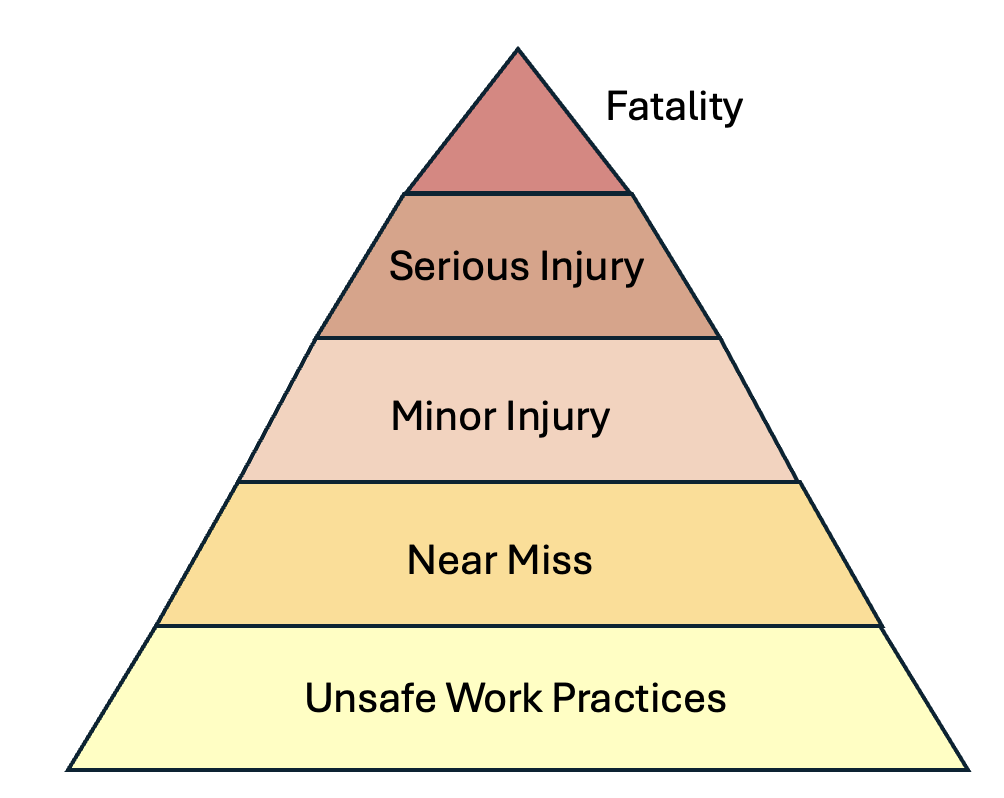
Figure 1:Safety Triangle showing that reducing the incidents of lower consequence events can reduce the quantity of higher consequence events.
Safety Metrics or Accident Statistics
Some safety metrics are training hours, near misses, number of lost time accidents, etc.
OSHA Recordable
Employers with more than 10 employees are required to keep a record of serious work-related injuries and illnesses. This is called the OSHA 300 log. It is required by the Occupational Safety and Health Administration (OSHA) which has legal authority to enforce workplace safety laws. Recordable injuries and illnesses are:
Any work-related fatality.
Any work-related injury or illness that results in loss of consciousness, days away from work, restricted work, or transfer to another job.
Any work-related injury or illness requiring medical treatment beyond first aid.
Any work-related diagnosed case of cancer, chronic irreversible diseases, fractured or cracked bones or teeth, and ruptured eardrums.
There are also special recording criteria for work-related cases involving: needlesticks and sharps injuries; medical removal; hearing loss; and tuberculosis.
Consequences from OSHA violations can be severe in addition to the injury and illness suffered by the employee. Consequence of an OSHA recordable incident could include: increased scrutiny from OSHA, potential fines and penalties, higher workers’ compensation costs, negative impact on company reputation, decreased employee morale, and increased insurance premiums; essentially, an OSHA recordable incident shows employees were unnecessarily harmed which can lead to significant financial repercussions.
Effective Safety Implementation Requires Knowledge
To effectively implement safety measures, it is crucial to have a deep understanding of both the technical aspects of the processes involved and the human factors that influence safety behavior. This includes knowledge of process design, hazard identification, risk assessment, and control measures, as well as knowledge of process safety information like chemical properties, process parameters, and equipment characteristics.
We will first review principles of hazards analysis and then review chemical process safety information that is necessary for effective safety implementation.
A great resource for chemical and physical processing equipment is the Visual Encyclopedia of Chemical Engineering EQuipment at https://
encyclopedia .che .engin .umich .edu/.