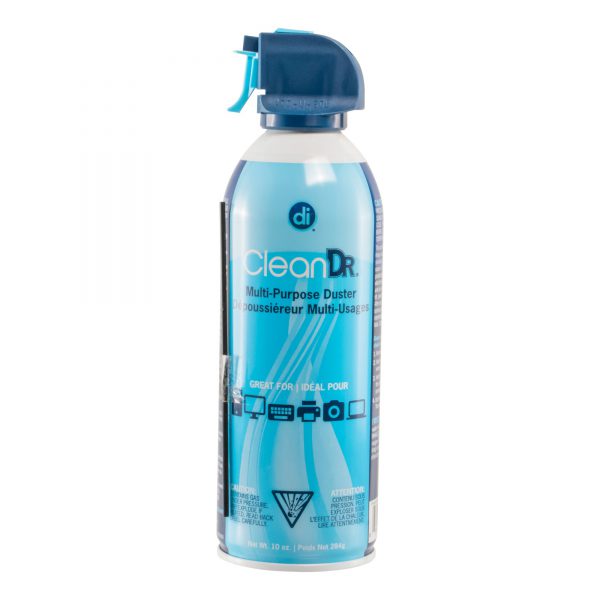
You’ll measure and model the behavior of the temperature and mass (using a scale) of a venting canned air duster. Below are the equations you’ll need to solve to estimate the temperature as a function of time and the mass loss as a function of time. You’ll then compare your model to the data you collect by tying a rubber band around the trigger and measuring the temperature and mass loss as a function of time with the temperature probe and scale.
Task 1: Review the below code
First define model parameters
Found online by searching for property data for difluoroethane plus the parameters of the can. Estimated the heat and mass transfer coefficients.
#import needed packages
import numpy as np
from tqdm import tqdm
import matplotlib.pyplot as plt
import pandas as pd
#model parameters for the venting of difluoroethane from a compressed container (all SI units)
lcan = 0.15 #150mm tall canister
dcan = 0.065 #diameter of can
harea = np.pi*lcan*dcan #150mm tall canister 65 mm diameter
marea = np.pi/4*dcan**2
Tsurr = 295 #surrounding temperature, K
Tref = 273 #reference temperature, K
factor = 0.9 #vent factor
gasConstant = 8.314 #J/mol/K
downstreamPressure = 12.2/14.5*1e5 #Pa, atmospheric pressure at test elevation approximately
gamma = 1.14 #ratio of specific heats of the gas
molecularWeight = 0.06605 #kg/mol
density = 2700 #kg/m3
CvVap = 59.58/gamma #J/mol/K, constant volume heat capacity
origmass = 10*0.0283495 #kg, amount initially present in the canister
Vol = lcan*np.pi/4*dcan**2#volume of the canister
#tuneable parameters
area = np.pi/4*0.0015**2 #orifice area for escaping gas,m2origmass0.283495Now specify the functions needed:
Venting through an orifice (mach number needed),
Saturated vapor pressure,
Equation of State,
Derivatives of moles and temperature (based on energy and mole balances)
#specify mach number function
def mach(upstreamPressure):
  tau = 500
  transition = np.tanh((upstreamPressure-downstreamPressure)/tau)/2+0.5
  ratio = transition*upstreamPressure/downstreamPressure + (1-transition)*downstreamPressure/upstreamPressure
  multiplier = 1*transition-1*(1-transition)
  mach_abs=np.sqrt(2/(gamma-1)*(ratio**((gamma-1)/gamma)-1))
  return min(1.,mach_abs)*multiplier

def dndtvent(pressure,temperature): #rate of change of moles from a pressurized scenario
  #calculate the mach number
  machno = mach(pressure)
  if downstreamPressure>pressure:
    drivingPressure = downstreamPressure
  else:
    drivingPressure = pressure
  dndt = drivingPressure*area*factor*np.sqrt(gamma/(gasConstant*temperature*molecularWeight))*machno*(1+(gamma-1)/2*machno**2)**((gamma+1)/(2-2*gamma))
  return dndt

def psat(temperature): #saturated vapor pressure using Antione's equation
  constants = [4.23406,896.171,-34.714]
  return (10**(constants[0]-(constants[1]/(temperature+constants[2]))))*1e5

def pressure(molesLiq,molesVap,tempVap): #gas pressure from eos, assumed ideal
  return molesVap*gasConstant*tempVap/(Vol-molesLiq*molecularWeight/density)
Include in the model the two phases with heat transfer
Additional parameters
Heat transfer
Psat and mass transfer functions
Derivatives of the moles and temperature are evaluated for each phase
hvap = 22000 #heat of vaporation, J/mol
CvLiq = 118.4 #Cp,J/mol/K, assuming the constant volume heat capcity is very close to this
#tuneable parameters
hcv = 40 #convective heat transfer coefficient, J/m2/K
km = 0.05 #mass transfer coefficient, m/s
#include heat transfer
def heatIn(temperature): #heat into the volume
return harea/2*hcv*(Tsurr-temperature) #1/2 factor for half the area for each of liq or vap
#include mass transfer between the liquid and the gas
def noutLiq(molesLiq,molesVap,tempLiq,tempVap): #mass transfer from the liquid surface
return km*marea*(psat(tempLiq)/(gasConstant*tempLiq)-pressure(molesLiq,molesVap,tempVap)/(gasConstant*tempVap))def derivatives(molesLiq,molesVap,tempLiq,tempVap):
noutL = noutLiq(molesLiq,molesVap,tempLiq,tempVap); noutV = dndtvent(pressure(molesLiq,molesVap,tempVap),tempVap)
dndtLiq = -noutL
dndtVap = noutL-noutV
dTdtLiq = (heatIn(tempLiq)-noutL*hvap+noutL*CvLiq*(tempLiq-Tref))/(molesLiq*CvLiq)
dTdtVap = ((noutV-noutL)*CvVap*(tempVap-Tref)+noutL*CvVap*gamma*(tempLiq-Tref)-noutV*CvVap*gamma*(tempVap-Tref)+heatIn(tempVap))/(molesVap*CvVap)
return [dndtLiq,dndtVap,dTdtLiq,dTdtVap]Task 2: Complete the simulation with the above functions
You’ll obtain the simulated temperature and mass of the liquid in the can as a function of time. You’ll add an integration step to obtain the variables from their derivatives.
Task 3: Obtain Experimental Data
Use the ESP32 and K-type Thermocouple to measure the temperature as the difluoroethane vents.
You can review the safety of such a procedure by reviewing this document: Safety calculations
Task 4: Aspen Plus Simulation
Simulate with Aspen Plus a separator with difluoroethane (CAS 75-37-6) where the inlet pressure is 85 kPa and the vapor fraction is 0. Estimate the heat transferred to the can (separator) such that the mass loss mimics the mass loss rate from the experiment.
I found simulating a batch condition to be difficult (I haven’t figured out how to do it yet). If you’re having problems as well, you can instead simulate a continuous flash drum with the following conditions:
6.3 bar inlet pressure of 100% difluoroethane (C2H4F2)
0.01 inlet vapor fraction
0.1 kg/hr inlet flow rate
1 bar pressure in the flash drum
Flash drum duty of 0 cal/sec
Report the resultant flow rates of the liquid and vapor and the temperature of the liquid and vapor.
Task 5: Complete the Documentation
Document your experience with the above tasks in a writeup according to the case study documentation.
Thermo Project Rubric
| Task | Points | Some criteria |
|---|---|---|
| Code Development | 10 | Existing code is used and further developed to estimate the temperature versus time of the gas and liquid inside the venting canned air canister. |
| Experimental Data | 10 | Experimental temperatures of the liquid and gas temperatures collected as a function of time while the can is venting. |
| Aspen Plus Simulation | 5 | An Aspen Plus simulation is completed according to the above directions. |
| Comparison | 10 | A plot showing the experimental and modeling result for the liquid and the gas is shown |
| Writeup | 25 | Documentation is complete according to the Case Study Documentation. It’s important to show evidence (plot or plots) of the modeling and experimental results and discuss the implications. Mention the results of the Aspen Plus simulation. |
| Total | 60 |
Note the intent is to gain experience with the modeling and experimental process and to compare those results. The modeling and experimental results may not be perfect. The modeling results may not be fully completed and you could still get full credit.